Why Do We Say “In One Fell Swoop”?
The phrase “one fell swoop” isn’t for the birds so much as it’s meant for humans. It gained its popularity thanks to the Bard of Avon himself. 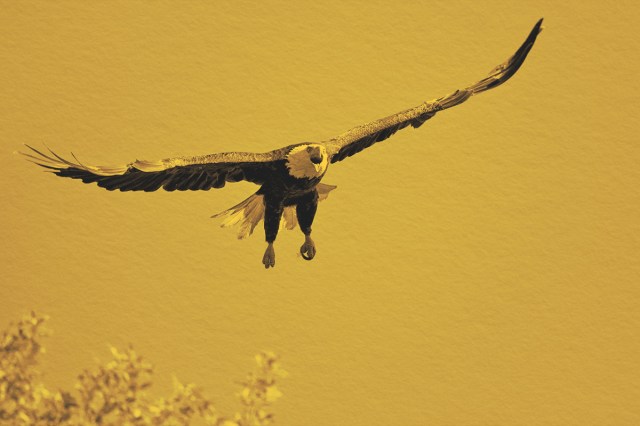
As the old superstition goes, it’s bad luck to say “Macbeth” inside a theater, lest you risk cursing the production. But there are plenty of other words and phrases coined in this Shakespearean tragedy that are perfectly OK to say wherever and whenever you choose. Take, for example, the phrase “one fell swoop,” whose popularity is owed to William Shakespeare.
As a whole, the phrase “in one fell swoop” means “with a single, quick action or effort.” But to better understand it, let’s look at the individual components. The word “fell” has nothing to do with the verb “to fall” but rather relates to an archaic adjectival use meaning “fierce,” “deadly,” or “sharp.” “Swoop” can be used to describe a rapid, downward motion, perhaps that of a bird plunging toward its prey. So “one fell swoop” describes a particularly vicious, swift, and effective action.
This brings us to Shakespeare, specifically Act IV, Scene 3 of Macbeth. Upon finding out that his wife and children have been murdered, the character Macduff exclaims:
Did you say all? O hell-kite! All?
What, all my pretty chickens and the dam
At one fell swoop?”



Comments
Post a Comment